In this guide
A difficult service conversation is hard to improve by telling staff to be more helpful. A rehearsal makes the behavior visible: how the employee opens the exchange, clarifies the task, handles uncertainty and closes with a next step. The safest practice material is a fictional case built around public information, with no resident or coworker identifiable in it.
Phoenix Human Resources describes organizational development and training among its responsibilities. This publication is independent and does not offer an official course, credit or required training. Employees should use their supervisor's approved learning arrangements and current department instructions. The exercise below is a small editorial practice method.
Choose one communication challenge
Do not combine every possible difficulty into a single scenario. A resident who cannot locate a service, a person who needs language assistance and someone returning after an unclear instruction create different practice goals. Start with one goal so that observers can identify what improved.
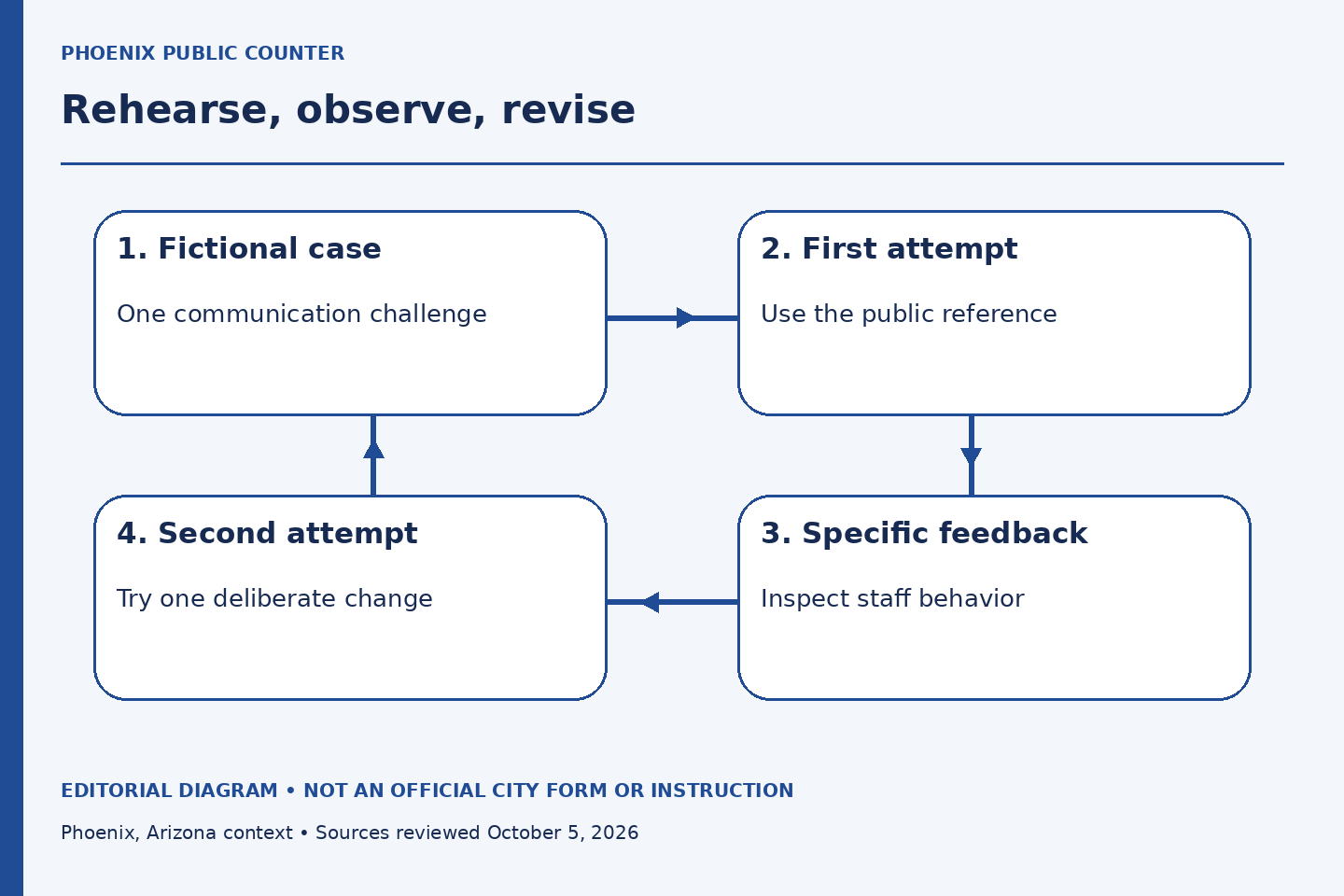
Write a short fictional prompt containing the task, what the resident already knows and one uncertainty. Avoid invented personal tragedy or a detailed medical history. The exercise needs a communication problem, not a dramatic backstory. Use a public service page as the factual reference and label everything else as hypothetical.
Agree on the employee’s role
Before beginning, name what the staff role can explain and what it cannot decide. A reception employee may identify a published process without making an eligibility determination. A peer coach should not reward an answer that sounds reassuring but exceeds that boundary.
Select three observable behaviors: clarify the task, explain one verified next step, and identify an unresolved point without guessing. Add a communication-support behavior when relevant. These are practice criteria, not a formal performance rating or a judgment about a person's suitability for employment.
Run a short first attempt
Let the fictional resident ask the question naturally. The staff participant responds using the approved public reference. The observer notes specific words or actions, not personality labels. “Named the office and its role” is more useful feedback than “seemed professional.”
If the participant reaches a question the source cannot answer, that is a productive moment. Practice saying what is known, what needs confirmation and where the authorized answer comes from. Do not force a neat ending by inventing availability, a deadline or an exception to policy.
Review the explanation from the resident’s side
Ask the person playing the resident what they believe the next step is. If their understanding differs from the employee's intent, inspect the explanation. Was the destination vague? Were too many steps delivered at once? Did the employee use a term that never appeared on the actual service page?
Feedback should be specific and changeable. Identify one phrase to revise or one question to ask earlier. Avoid a long list that makes the second attempt feel like a test of memory. The purpose is to improve one behavior enough that the participant can recognize it in real work.
Repeat with one deliberate change
Run the same scenario again after the revision. Compare the clarity of the next step and the handling of uncertainty. A better second attempt may be slower because the employee pauses to verify a source. Speed is not the only sign of a usable conversation.
Close by noting the improvement and the remaining question for the responsible trainer or supervisor. Do not record real case details or treat the rehearsal as evidence that a person is certified for a task. The practical outcome is a more deliberate communication habit, ready to be used within authorized work.
Sources and limits
Official public sources checked October 5, 2026. Examples and exercises are original editorial illustrations, not City records or instructions.
- City of Phoenix Human Resources
Public HR responsibilities and official employee eCHRIS link. Does not expose internal screens or establish a personal entitlement.
- Citywide Accessibility Resources
Published accessibility resources across departments. Individual accommodations and legal obligations require authorized review.